English
 русский
 Español

Everyone is talking about interdental brushing, but why do we need it?
Content
- 1 The Gap in Your Oral Care Routine You Didn't Know About
- 2 What Exactly Are Interdental Brushes?
- 3 Why the Space Between Your Teeth Is So Vulnerable
- 4 Interdental Brushes vs. Dental Floss: What the Evidence Says
- 5 Choosing the Right Size: Why This Step Is Non-Negotiable
- 6 How to Use Interdental Brushes Correctly
- 7 Who Benefits Most from Interdental Brushes?
- 8 What to Expect When You First Start
- 9 Making It a Habit That Sticks
The Gap in Your Oral Care Routine You Didn't Know About
Brushing your teeth twice a day feels like enough. You're consistent, you use a good toothpaste, maybe you even invested in an electric toothbrush. But if you're skipping the spaces between your teeth, you're leaving roughly 40% of each tooth's surface completely uncleaned. That's where interdental brushes come in — and that's exactly why dentists, hygienists, and oral health researchers have been championing them with growing urgency. These small, bristled tools are designed to reach where your toothbrush physically cannot, and mounting clinical evidence suggests that using them regularly can dramatically reduce gum disease, cavities between teeth, and bad breath.
What Exactly Are Interdental Brushes?
Interdental brushes — sometimes called interproximal brushes or proxy brushes — are tiny cylindrical or tapered brushes mounted on a thin wire handle. They come in a range of sizes, typically identified by color-coded labels from extra-extra-small (0.6mm) up to extra-large (1.5mm or wider). The bristles are designed to fit snugly into the gaps between teeth, physically dislodging plaque and food debris rather than simply flushing it away.
Unlike dental floss, which works through a cutting and scraping motion in a single plane, interdental brushes work in three dimensions, scrubbing the curved surfaces of adjacent teeth simultaneously. This mechanical action is particularly effective at removing the sticky biofilm (plaque) that accumulates in the gum margin — the exact area where gingivitis and early periodontitis begin.
Why the Space Between Your Teeth Is So Vulnerable
The contact point between two teeth creates a naturally sheltered environment. Saliva's natural buffering and antibacterial properties have limited access there. Food particles and bacteria accumulate with ease. Over time, the acid produced by bacteria erodes tooth enamel, creating interproximal cavities — some of the most common yet preventable dental problems in adults. Simultaneously, bacteria at the gumline trigger an inflammatory response. Left unchecked, this inflammation progresses from reversible gingivitis to irreversible periodontitis, which can ultimately lead to bone loss and tooth loss.
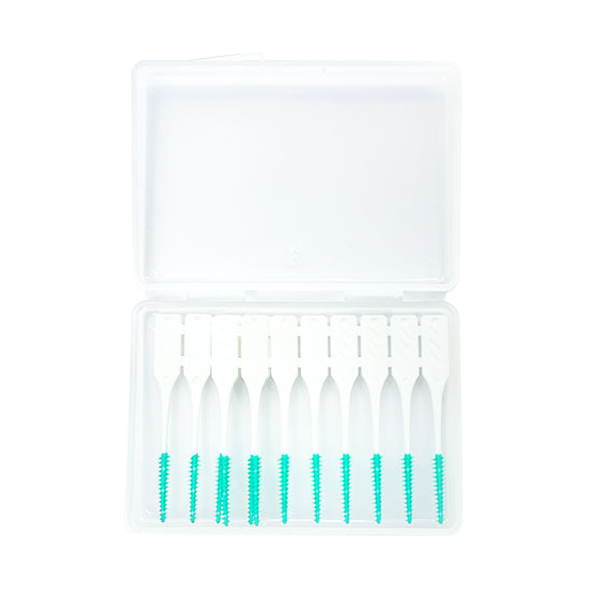
Standard toothbrush bristles simply cannot reach deeply enough into these narrow spaces, especially around the gumline. This structural limitation is not a flaw in brushing technique — it's a physical constraint. Interdental cleaning is not optional supplementation; according to guidelines published by the European Federation of Periodontology, it is a necessary and distinct step in daily oral hygiene.
Interdental Brushes vs. Dental Floss: What the Evidence Says
For decades, flossing was the gold standard recommendation for interdental cleaning. But a growing body of research has begun to shift that consensus. A systematic review published in the Journal of Clinical Periodontology found that interdental brushes were significantly more effective than floss at reducing both plaque levels and gingival bleeding in patients with mild to moderate gum disease. The key reason: surface contact.
Floss is a single strand that must be manually curved in a "C" shape around each tooth — a technique that requires practice and dexterity that many people never fully master. Interdental brushes, by contrast, are self-adapting. As the brush is moved in and out of the gap, the bristles naturally conform to both tooth surfaces simultaneously without demanding precise hand technique.
A Side-by-Side Comparison
| Feature | Interdental Brush | Dental Floss |
| Plaque Removal Efficiency | High (3D contact) | Moderate (2D contact) |
| Ease of Use | Easy for most users | Requires technique |
| Suitable for Braces/Implants | Yes | Difficult |
| Reusability | Multiple uses | Single use |
| Best For | Wider or open gaps | Very tight contacts |
It is worth noting that for people with extremely tight contacts between teeth — common in younger adults with naturally snug tooth alignment — floss may still be the more practical choice. In many cases, both tools can be used complementarily depending on the location in the mouth.
Choosing the Right Size: Why This Step Is Non-Negotiable
Using the wrong size interdental brush is one of the most common mistakes people make. A brush that is too small will slide through the gap without making meaningful contact with the tooth surfaces, doing little more than pushing debris further in. A brush that is too large will be forced into the space, potentially damaging delicate gum tissue and irritating the papilla — the small triangle of gum that sits between teeth.
The ideal fit is snug but not forced. When inserted correctly, you should feel gentle resistance and the bristles should make contact with both adjacent tooth surfaces. Most people require different sizes for different areas of the mouth — molars typically have wider gaps than front teeth.
Common Size Guidelines by Color Code (ISO Standard)
- Pink (0.4mm): Very tight gaps, often front lower teeth
- Orange (0.45mm): Slightly wider tight contacts
- Red (0.5mm): Standard size for many adults, good starting point
- Blue (0.6mm): Moderate gaps, common in premolar regions
- Yellow (0.7mm): Wider gaps, typical around molars
- Green (0.8mm) and above: Open embrasures, post-orthodontic spaces, or areas with gum recession
Your dental hygienist can measure your interdental spaces precisely and recommend the correct sizes during a routine visit. Many practices offer free starter packs of different sizes so you can identify the right fit before committing to a product.
How to Use Interdental Brushes Correctly
Correct technique takes less than two minutes once you know what you're doing. Here is a step-by-step breakdown to get maximum benefit from each session:
- Choose the right size — Start with the smallest size and work up until you find a snug but comfortable fit.
- Angle the brush slightly — Tilt the brush toward the gumline at roughly a 45-degree angle, mirroring the natural angle of the tooth root.
- Insert gently — Never force the brush into a tight space. If there is strong resistance, try a smaller size.
- Move back and forth — Use 2–3 gentle passes in each gap. You do not need to rotate or twist the brush.
- Rinse between gaps — Rinse the brush under running water as you move from gap to gap to avoid redepositing bacteria.
- Work systematically — Start at one side of your upper teeth and work around to the other side, then repeat for the lower arch.
- Clean and store the brush — Rinse thoroughly after use and allow to air-dry. Replace when bristles are bent or worn, typically after 1–2 weeks.
Interdental brushing is best done before your regular toothbrushing session. This sequence ensures that loosened plaque and debris are swept away by the toothbrush rather than left sitting between teeth. Some dentists also recommend applying a small amount of fluoride toothpaste directly to the brush to enhance the protective benefit in the interproximal zone.
Who Benefits Most from Interdental Brushes?
While everyone can benefit from interdental cleaning, certain groups have a particularly strong case for making interdental brushes their primary tool:
- People with braces or orthodontic appliances: Floss is notoriously difficult to thread under wires. Interdental brushes fit effortlessly between brackets and around wires, making thorough cleaning achievable without special floss threaders.
- Dental implant patients: The peri-implant tissue around an implant is structurally different from natural gum and is highly vulnerable to bacterial infection (peri-implantitis). Interdental brushes are the recommended cleaning tool by most implant specialists.
- People with gum recession: Recession widens the spaces between teeth, making floss less effective and interdental brushes better suited to clean the larger embrasures.
- People with reduced manual dexterity: Those with arthritis or limited hand mobility often find the handle of an interdental brush far easier to manipulate than a length of floss.
- Bridge wearers: A dental bridge creates a non-flossable section beneath the pontic (the false tooth). Interdental brushes slide easily under bridges to keep the underlying gum tissue healthy.
What to Expect When You First Start
If your gums bleed during the first few days of interdental brushing, don't panic and don't stop. Bleeding is a sign of existing inflammation — it means the tissue is already irritated by plaque buildup. Consistent daily cleaning will reduce that inflammation within one to two weeks, and the bleeding will subside as the gums become healthier. If bleeding persists beyond two weeks, or if you experience pain, consult your dentist to rule out underlying periodontal disease that may need professional treatment.
Many new users also notice that their breath improves noticeably after establishing an interdental brushing habit. The sulfur compounds responsible for bad breath are largely produced by anaerobic bacteria living in the oxygen-depleted environment between teeth. Removing their food source and disrupting their colonies regularly has a direct, measurable impact on oral malodor.
Making It a Habit That Sticks
The biggest obstacle to interdental brushing is not technique — it's consistency. Research consistently shows that even people who know they should clean between their teeth fail to do so regularly. Habit stacking is an effective strategy: attach interdental brushing to an existing routine, such as brushing your teeth at night. Keeping your interdental brushes visible on the bathroom counter rather than tucked away in a drawer also dramatically increases compliance.
Start with just one arch per night if doing all gaps feels overwhelming. Within a few weeks, you'll find the process takes under two minutes for a full mouth and feels as natural and non-negotiable as brushing itself. The return on that small time investment — fewer fillings, healthier gums, fresher breath, and potentially lower lifetime dental costs — makes interdental brushes one of the most impactful oral health habits you can build.
We will provide a professional and reasonable quotation
as soon as possible for any customer inquiries.