English
 русский
 Español

What Makes a Soft Bristle Flat Hole Toothbrush Better at Removing Stains?
Content
- 1 What "Flat Hole" Toothbrush Design Actually Means
- 2 Why Soft Bristles Are Better for Stain Removal Than Hard
- 3 How Stains Form on Teeth and Why Brush Design Matters
- 4 Comparing Toothbrush Bristle Configurations for Stain Removal
- 5 The Correct Brushing Technique for Maximum Stain Removal
- 6 Toothpaste Selection to Complement Soft Bristle Brushing
- 7 How Often to Replace a Soft Bristle Flat Hole Toothbrush
- 8 Practical Habits That Enhance Long-Term Stain Prevention
The toothbrush you use every day has more engineering behind it than most people realize — and the specific combination of soft bristles, flat bristle arrangement, and hole-pattern tufting found in certain modern toothbrush designs is not a marketing gimmick. It represents a meaningful convergence of dental research on enamel safety, plaque removal mechanics, and stain elimination that produces measurably better cleaning outcomes for many users compared to traditional rounded or dome-shaped bristle configurations. Understanding what these design features actually do — and how to use them correctly to maximize stain removal without damaging enamel or gum tissue — is practical knowledge that affects the health and appearance of your teeth every single day.
What "Flat Hole" Toothbrush Design Actually Means
The term "flat hole" in toothbrush design refers to a bristle head configuration where the tufts are arranged in a flat, level plane — as opposed to the contoured, domed, or angled multi-level bristle patterns found in many contemporary toothbrushes — and where the bristle tufts themselves are anchored through holes drilled or molded into a flat base plate rather than being set into a curved or raised platform. This flat base creates a predictable, even contact surface where all bristle tips engage the tooth surface simultaneously at the same pressure level, rather than having the center tufts pressing harder against teeth while outer tufts barely make contact, or vice versa.
The flat arrangement has practical consequences for cleaning effectiveness. When a flat-hole head is placed against a tooth surface and moved in a brushing stroke, all tufts contribute equally to plaque disruption and stain removal across the full contact width of the head. In contrast, a domed or scalloped bristle arrangement concentrates initial contact in the elevated center tufts, which can miss the stain deposits that accumulate in the natural depressions between teeth and along the gumline — exactly the locations where discoloration from coffee, tea, and food pigments tends to be most persistent. The flat configuration also makes the toothbrush's cleaning action more consistent and reproducible, which is an advantage for users who want reliable technique-independent results.
Why Soft Bristles Are Better for Stain Removal Than Hard
There is a persistent misconception that harder bristles remove stains more effectively because they exert more abrasive force on tooth surfaces. The clinical reality is the opposite: hard and medium bristles are more likely to physically damage enamel and abrade gum tissue than to remove extrinsic stains more thoroughly, and the damage they cause can paradoxently worsen long-term staining by creating microscopic enamel surface roughness that provides additional attachment sites for chromogenic (color-producing) compounds from food and beverages.
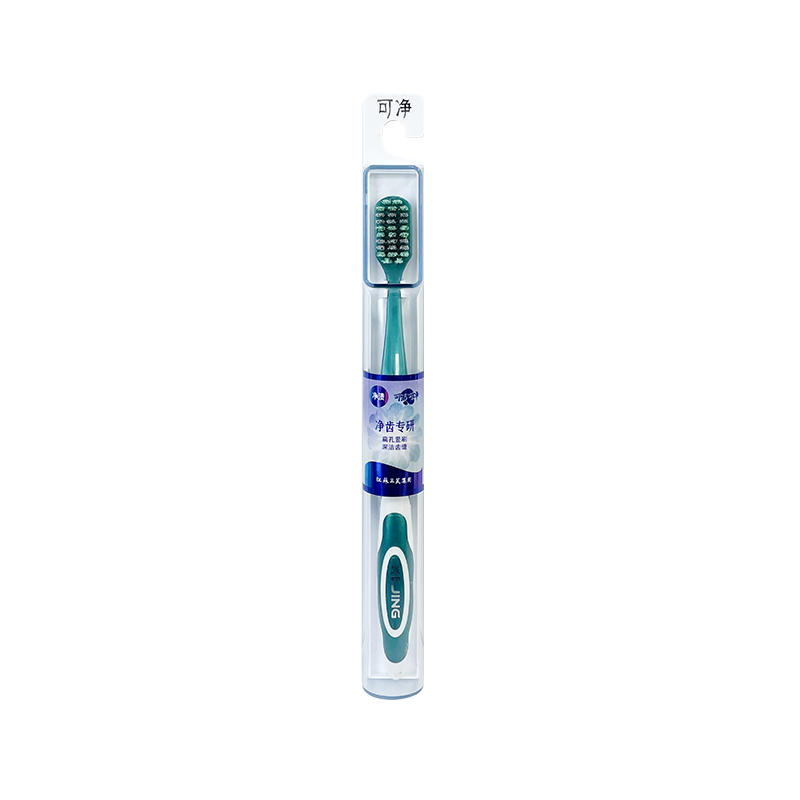
Soft bristles — typically defined as nylon filaments with a diameter of 0.15 mm to 0.18 mm — flex readily under gentle brushing pressure, which allows their tips to access and sweep across the slightly concave surfaces between and around teeth where stain deposits accumulate. A harder bristle at equivalent pressure will not flex into these contours — it contacts the high points of the tooth surface more aggressively but misses the recessed areas where stain concentration is highest. Soft bristles also allow the brusher to apply adequate strokes along the gumline and into the sulcus (the shallow groove between tooth and gum) without the gum tissue recession and enamel wear at the cervical (gum-line) region that harder bristles cause over time. This gum-line access is critical for stain removal because the gumline area accumulates pigment deposits from tannins in tea and coffee at a high rate due to the slightly porous enamel surface in that region.
Bristle Filament Tip Shape and Its Effect on Stain Removal
The tip of each bristle filament has a significant effect on both cleaning effectiveness and tissue safety. Poorly manufactured toothbrush filaments have blunt, flat-cut tips with sharp edges that can scratch enamel and lacerate gum tissue. Quality soft bristle toothbrushes — including those marketed for stain removal — use end-rounded filaments where the tip of each bristle is mechanically or chemically rounded and polished to a smooth, hemispherical end. This rounding eliminates the scratching effect while maintaining the filament's ability to engage and disrupt the pellicle (the protein film on tooth surfaces to which staining compounds adhere) at the tooth surface. Some advanced toothbrushes use tapered or ultra-fine filament tips that taper from a thicker shaft to a very fine point — these thin tips can penetrate further into interdental spaces and gum sulcus areas than standard-diameter rounded filaments, providing enhanced access to the locations where stain deposits are most concentrated and most difficult to disrupt with standard brushing.
How Stains Form on Teeth and Why Brush Design Matters
To understand why specific brush designs remove stains more effectively, it helps to understand the mechanism by which extrinsic tooth stains form in the first place. The process begins with the acquired pellicle — a thin, protein-rich film that forms on tooth enamel within minutes of cleaning from salivary proteins, glycoproteins, and immunoglobulins. This pellicle is not harmful and actually protects enamel, but it provides a molecular attachment scaffold to which chromogenic compounds — the staining molecules in coffee, tea, red wine, berries, and tobacco — can bind.
The chromogenic compounds most responsible for tooth discoloration include tannins (from tea and red wine), polyphenols (from coffee and dark-colored foods), and chlorhexidine-stain complexes (from medicated mouthwashes). These compounds bind to the pellicle protein matrix through hydrogen bonding and hydrophobic interactions, and over repeated exposures the bound layer accumulates and darkens, eventually producing the visible yellow, brown, or gray discoloration that most people associate with stained teeth. The pellicle and its bound chromogens are removed by mechanical disruption — physical brushing — rather than by chemical dissolution alone, which is why effective stain removal is fundamentally a mechanical cleaning challenge that brush design directly addresses.
Stain deposits are not uniformly distributed across the tooth surface. They concentrate in three specific areas: the gumline margin where the pellicle tends to be thicker and less disrupted by natural oral fluid flow; the interproximal spaces between teeth where toothbrush access is limited and chromogens accumulate from inadequate removal; and in the pits and fissures of molar occlusal surfaces where chromogens from food contact pool and are trapped. A flat-head soft bristle toothbrush's consistent full-contact geometry is most relevant to gumline and smooth surface stain removal — the interdental areas require separate attention through flossing or interdental brushing regardless of which toothbrush is used.
Comparing Toothbrush Bristle Configurations for Stain Removal
Not all soft-bristle flat-hole toothbrushes are equal in their stain removal capability. The specific tuft density, tuft pattern, bristle diameter, and end-rounding quality all affect performance. The following comparison covers the main configuration variables and their practical implications for stain removal effectiveness.
| Feature | Standard Configuration | Stain-Optimized Configuration | Practical Benefit |
| Bristle tip | Flat-cut or lightly rounded | End-rounded or tapered | Safer on enamel; better sulcus access |
| Tuft arrangement | Domed or multi-level | Flat, even plane | Uniform contact across full head width |
| Bristle diameter | 0.20 – 0.25 mm (medium) | 0.12 – 0.18 mm (soft/extra-soft) | Flexes into contours; gumline access |
| Tuft density | Standard spacing | High-density closely spaced tufts | More bristle-tips per cm² for stain disruption |
| Head size | Standard or large | Compact or medium | Better access to posterior teeth and gumline |
The Correct Brushing Technique for Maximum Stain Removal
Even the most effectively designed soft bristle flat-hole toothbrush will not remove stains optimally if used with poor technique. The method of brushing — the angulation of the brush head, the stroke pattern used, the pressure applied, and the time spent on each tooth surface — determines how effectively the bristle tips reach and disrupt the stain-loaded pellicle at the tooth surfaces where discoloration accumulates most heavily.
Brush Placement and Angle for Gumline Stain Removal
For stain removal at the gumline — the most discoloration-prone area — position the flat bristle head at a 45-degree angle to the gum margin, so that the bristle tips point partly toward the gum sulcus and partly along the tooth surface. This angled placement allows the soft bristle tips to both sweep the visible tooth surface and penetrate a short distance into the sulcus where the pellicle transitions from enamel to root surface and where chromogen accumulation is often greatest. Pressing too hard defeats the purpose — soft bristles need only light-to-moderate pressure (approximately 150 to 200 grams of force, roughly the pressure you would use to depress a kitchen scale by half a centimeter) to flex and access gum margin stain deposits. Excessive pressure flattens the bristles and reduces their tip-penetration effectiveness while increasing enamel abrasion risk.
Stroke Pattern and Duration
The most effective stroke for stain removal with a flat-head soft bristle toothbrush is a combination of small horizontal vibrating strokes (moving the brush head a few millimeters back and forth while maintaining the 45-degree angle) followed by a sweeping stroke away from the gum margin toward the biting edge. The small vibrating component disrupts the pellicle-chromogen matrix at the gumline without laterally abrading the enamel; the sweeping stroke carries the loosened material away from the tooth surface rather than redistributing it. Spend approximately 30 seconds on each quadrant of the mouth (upper right, upper left, lower right, lower left) for a total of two minutes minimum per brushing session. Research consistently shows that two-minute brushing removes significantly more plaque and stain than 45-second to one-minute brushing that most people default to without deliberate attention to time.
Toothpaste Selection to Complement Soft Bristle Brushing
The toothpaste used in combination with a soft bristle flat-hole toothbrush significantly affects the degree of stain removal achieved, and selecting an appropriate toothpaste prevents the situation where good brush technique is undermined by a paste that is either too abrasive for safe use with soft bristles or too mild to effectively disrupt stubborn stain deposits.
- Whitening toothpastes with silica abrasives: Many whitening toothpastes use hydrated silica as their primary abrasive agent. Silica is effective at disrupting and removing the chromogen-loaded pellicle layer when used with soft bristle technique, and is considered safe for enamel at the concentrations used in commercial toothpastes (RDA — Relative Dentin Abrasivity — values below 250 are generally accepted as safe). The combination of soft bristles (which provide gentle mechanical action and reach into contours) and silica abrasive toothpaste (which chemically assists pellicle disruption) is particularly effective for regular maintenance of stain-free surfaces.
- Enzymatic toothpastes: Toothpastes containing proteolytic enzymes such as papain or bromelain target the protein matrix of the acquired pellicle directly, breaking the peptide bonds that hold the chromogen-protein complex together. These enzyme-based formulas work synergistically with the mechanical disruption of soft bristle brushing — the enzymes weaken the attachment between the pellicle and tooth surface, making the stain more susceptible to mechanical removal by the bristle tips. Enzymatic toothpastes are particularly effective for tea and coffee stains where tannin-protein binding is the primary staining mechanism.
- Charcoal toothpastes (with caution): Activated charcoal toothpastes are heavily marketed for stain removal but carry significant limitations. Charcoal particles are highly abrasive — many formulations have RDA values well above safe limits — and their abrasive action with soft bristles can cause net enamel damage that outweighs any short-term stain removal benefit. If choosing a charcoal toothpaste, verify the RDA value is below 150, and use only once or twice per week rather than twice daily to limit cumulative abrasive exposure.
- Fluoride content: Regardless of stain removal capability, ensure the toothpaste contains fluoride at a minimum of 1,000 ppm (parts per million) for adults. Stain removal without enamel remineralization creates a situation where any microabrasion from brushing is not counterbalanced by fluoride-facilitated enamel repair, increasing cavity risk. Most adult whitening and stain-removal toothpastes contain 1,000 to 1,450 ppm fluoride — confirm this before purchase if buying a specialized stain-removal formula.
How Often to Replace a Soft Bristle Flat Hole Toothbrush
A soft bristle flat-hole toothbrush's stain removal capability degrades progressively as the bristle filaments wear through use. The most visible indicator of bristle wear is fraying and spreading — when tufts that were originally straight and upright begin to splay outward in multiple directions, the bristle tips are no longer positioned to engage tooth surfaces and gum margins at the correct angles for either plaque removal or stain disruption. A frayed brush is less effective at stain removal and more likely to cause gum irritation from the irregular pressure distribution of spread bristles contacting soft tissue at unpredictable angles.
The standard dental recommendation is to replace a toothbrush every three months — or sooner if bristle wear is visible before that interval. In practice, the rate of bristle wear depends heavily on brushing pressure: people who brush with heavy pressure (a common habit, often unintentional) may need to replace their brush every six to eight weeks, while those with naturally light technique may find their brush remains in good condition for the full three months. A useful indicator is that most modern toothbrushes incorporate colored bristle indicator dye — typically blue — that fades progressively with use. When the blue has faded to half its original intensity (typically at the center of the bristle length), the manufacturer's recommended replacement interval has been reached regardless of visible fraying. This indicator is more reliable than time-based replacement alone because it reflects actual wear rather than calendar elapsed time.
Practical Habits That Enhance Long-Term Stain Prevention
Using a soft bristle flat-hole toothbrush with correct technique is the foundation of effective stain removal — but several complementary habits significantly reduce the rate at which new stains form, reducing the cleaning burden on the brush and maintaining whiter teeth between professional dental cleanings.
- Rinse with water immediately after consuming staining beverages: Rinsing within a minute or two of drinking coffee, tea, or red wine disrupts the initial binding of chromogenic compounds to the pellicle before the attachment is fully established. This does not replace brushing but meaningfully reduces the total stain load that accumulates over the day for those who consume high-stain beverages regularly.
- Brush before coffee, not after: Brushing immediately after consuming acidic beverages — including coffee, fruit juice, and carbonated drinks — occurs when the enamel's surface has been temporarily softened by acid. Brushing at this moment increases abrasive removal of softened enamel. Instead, brush before your morning coffee, then rinse with water afterward. The pellicle that re-forms on the clean tooth surface after brushing still binds chromogens, but the tooth starts from a clean baseline rather than from accumulated overnight stain.
- Use a straw for staining beverages: Drinking coffee, tea, cola, and similar beverages through a straw reduces direct contact between the chromogenic liquid and the front tooth surfaces — particularly the upper and lower incisors — where staining is most cosmetically visible. While this is impractical in all situations, using a straw consistently for cold staining beverages is one of the easiest behavioral changes that measurably reduces front-tooth stain accumulation over time.
- Schedule regular professional cleaning: Even the most diligent home oral hygiene routine with the best-designed toothbrush will not remove calcified deposits (calculus or tartar) that have hardened on the tooth surface over weeks or months. Calculus provides the roughest, most porous surface for chromogen attachment of any material found in the oral environment, and its presence dramatically accelerates new stain formation. Professional cleaning every six months removes calculus and polishes the enamel surface, restoring the smooth, low-attachment-energy surface that a good home stain removal routine can then maintain effectively between appointments.
The soft bristle flat-hole toothbrush is not a magic solution for stained teeth — no toothbrush is — but its specific combination of design features genuinely addresses the biomechanics of extrinsic stain formation and removal more effectively than many alternatives. Used with the right technique, the right toothpaste, and the complementary habits that reduce stain accumulation between brushings, it represents a practical and dentist-approved approach to maintaining noticeably cleaner, less discolored teeth as a consistent part of your daily oral health routine.

We will provide a professional and reasonable quotation
as soon as possible for any customer inquiries.